

What's missing in AI-driven organizational change
It's certainly something of consequence...
There’s a classic framework from the 90’s that various consultants have been quietly reaching for ever since—the “Managing Complex Change” model. Deceptively simple, and quite enduringly useful. The gist is that successful change requires five ingredients working together: vision, skills, incentives, resources, and an action plan. But if you remove one, then you notice a rather predictable flavor of team dysfunction.
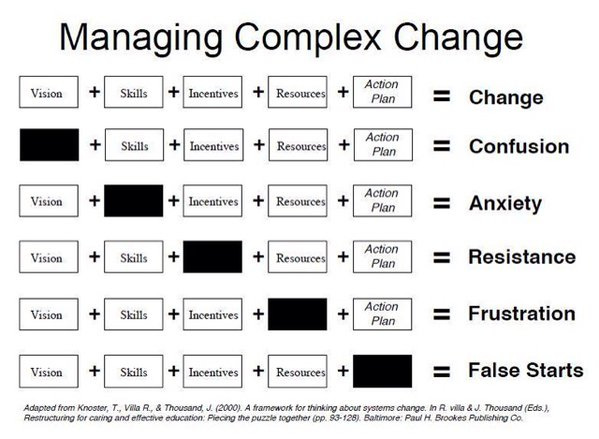
No vision → confusion. No skills → anxiety. No incentives → resistance. No resources → frustration. No action plan → False starts, pilots/POC’s stalled out, and yet another quarter of “revolutionary” AI initiatives that go basically nowhere. 🫠 Sigh…
So that 30-something year old model is still viable! But what’s changed is what we’re using it to navigate.
🤖 The AI Twist
AI isn’t just raising the bar on these five elements—it’s redefining them in ways the original framework never could have anticipated. Let’s take a look:
✦ Vision can’t be just “use AI to be more efficient.” That’s a race to the bottom, and the floor is further down than most org leaders/execs want to admit. Real vision identifies the human value you want to amplify—not automate! The distinction isn’t just semantic. It’s really the difference between designing a future you want to inhabit versus digitizing the current dysfunction at scale. 🤨
✦ Skills aren’t about turning everyone into prompt engineers. They’re about AI fluency—knowing when to (or not!) leverage the AI, and more importantly, when to assert human judgment against it. That second part is admittedly getting harder to say out loud in places where velocity has become the only supported value.
✦ Incentives must evolve to honor growth, not terrify about replacement. The effective orgs are exploring hybrid roles that actually mean something to the people doing hard work, by honoring their identity, career, and growth. It’s not just incentives about comp, either. They’re about what behavior (and speech) is sanctioned, praised, and protected. Orgs that penalize AI hesitation are building a particular, frankly scary, kind of future—whether they intend to or not. 😬
✦ Resources now include psychological safety—time and space to experiment, fail, and build AI capability without ROI panic breathing down the team’s neck. This is harder than it sounds in environments where dissent gets reframed as inefficiency rather than as a form of care.
✦ Action plans can’t assume stability. The AI landscape moves too fast for fixed blueprints. Plans need structured flexibility—scheduled checkpoints to reassess models, revisit assumptions, upgrade capabilities, and pivot without shame. The plan is a hypothesis, not a contract. 🙃
😶🌫️ The Hidden Sixth Element
What the framework misses—and what twenty years in the trenches, and a political moment that keeps clarifying itself, has taught me—is consequences.
Not consequences just as a risk tabulation. Nor as a compliance checkbox or a legal review. Consequences as a moral commitment to the second- and third-order effects of what you build: What systems are we reinforcing? What friction are we removing, and should we? When we automate judgment, whose biases are we encoding? When we augment capabilities, whose capabilities are we actually amplifying? 🤔
This is the difference between meaningful transformation versus digitizing dysfunction at speed.
And there’s a reason this question keeps getting tabled. We are living through a certain historical moment in which consequence is being systematically escaped by the people with the most power to cause harm. Leaders in tech, culture, and politics move fast, cause damage, and walk away—insulated by status, wealth, and the sheer velocity of the next initiative. The accountability that should follow never quite arrives. The reckoning never quite comes. 😑
Inside organizations, this dynamic has a quieter shadowy feel. When AI adoption gets framed as inevitability, asking “then what?” gets coded as resistance. Caution becomes risk aversion. The person who slows the room down to ask what you’re actually building—and for whom, and at whose expense—gets scheduled for an HR conversation about their alignment with “the team”. 🙄
So let’s name it plainly: asking “then what?” inside your organization is a small but real, necessary act of resistance. Not heroic. Not career-ending. Just the refusal to let the question disappear. The insistence that someone, somewhere, should have to answer for what gets built. BTW, that’s why people still matter in organizations—but that’s a separate post for another time!
This is where the designer’s position becomes most relevant—and most urgent. Design, at its best, has always been a practice of consequence-awareness. Not just can we? but should we? Not just should we? but then what? The designer as citizen-professional, not merely as employee, carries an obligation that doesn’t end at the boundary of the organization chart.
The obligation extends to the people downstream who will never be in the room when the decision gets made.
Staying oriented toward that obligation—rather than past it—is the practice the sixth element demands. Think of it as a compass. Not one that points north, and not one that hands you a destination. One that keeps you in the right relationship to what you’re building and who it affects, especially when everything around you is moving fast and the room just wants to accelerate. 🫠
🙌🏽 Now It’s Your Move
OK, so the original model of change still works. Before you dive into that next AI initiative, confidently ask which ingredient is missing. You can’t hide it—missing vision shows up in every confused standup, missing skills in every anxious Slack thread, missing resources in every frustrated retro FigJam board.
Then after you’ve checked those five, sit with the sixth one.
Not only about what could go wrong—that’s base level risk management. This question is more direct and important: Who is being asked to absorb the consequences of what we’re building? And are we willing to be responsible for that? 🤔
The model is simple, the execution is not. And if you think you’ve nailed all five but still feel stuck—or worse, feel fine when you probably shouldn’t—start looking for the sixth one. The one that asks not just can we? but should we? And even more importantly: then what?
That question is never off the agenda. Even when the agenda says otherwise. 🙏🏽
What’s your organization’s missing ingredient?