

A timely layer for design leadership
On durée, development, and why leadership can’t be scheduled
There’s a particular genre of career advice that has become popularized across LinkedIn, Medium, and now every AI-generated newsletter in your inbox. 😒
You know the one…
How I got promoted in 90 days.
The five things senior designers do differently.
Your mid-year career check-in template.
Like seriously? 😅 It arrives with the confidence of a metrics dashboard: clean, quantified, reassuring. The implicit promise is that growth can be project-managed—that if you instrument the right behaviors over the right interval, development will follow as reliably as that sprint velocity metric. Hmm!
And if we’re being totally honest, I’ve written a version of that content myself too! Just a few weeks ago, in fact. Yet I don’t really regret it. The four-layer framework I offered—personal, emotional, spiritual, pragmatic—is genuinely useful as a self-reflective prompt.
But I’ve been sitting with this nagging kind of discomfort since publishing it. Something I couldn’t quite name until I remembered Henri Bergson’s Time and Free Will, a text I first encountered in our graduate seminar at CMU under Dick Buchanan, buried in a thick stack of readings I probably didn’t fully appreciate until literally years later.
Always funny how that works, right? 😏
Basically, Bergson distinguished between measurable time—the articulated time represented by clocks, calendars, and numbers—and durée: time as it is actually lived. Duration is qualitative rather than quantitative, a continuous flow in which moments aren’t neatly segmented but permeate one another, carrying the past into the present.
•
You are not simply a sequence of states.
•
You are a flow. ∞
•
And the flow can’t be audited. 🤨
I’ve actually watched this play out with a designer I had mentored—or, more accurately, a composite of designers I’ve encountered across years of this work. The pattern is common enough to be archetypal.
They were talented, motivated…clearly ambitious. ✅
They arrived one day with an earnest, detailed, color-coded 90-day plan mapping the behaviors & deliverables that would demonstrate readiness for the next level (Lead, Principal, whatever it may be).
But what the plan couldn’t schedule was the slower, less obvious work:
Learning to receive difficult feedback without immediately becoming defensive.
Developing the emotional steadiness to hold a position under pressure.
Building relational trust (and earning respect) through dozens of small moments that don’t show up in a performance review.
When the promotion didn’t come, the reactions revealed in all its glory the very developmental aspects the plan had been designed to skip over. 🫠
The plan wasn’t naïve, per se. It was perfectly rational & procedurally optimized.
Just rational in the wrong kind of time.
So what does leadership career development in durée actually look like? 🤔
It doesn’t really declare itself, “now I’m advancing to level 5”. More often it subtly arrives sideways, viewed only in retrospect, in a slowly recognized manner.
For instance, you realize later you handled a difficult stakeholder conversation differently than you would have two years ago. You didn’t consciously deploy a new technique necessarily. Something else had simply shifted—accumulated, settled, become a new default beneath your awareness. A kind of informed intuition, a subtle confidence of repertoire & approach.
Or feedback that would have destabilized you at age 30, now lands differently at age 40. Sure, you could say that you have “no more fucks to give” 😆 but that’s eluding something more significant…
Not because you’ve grown a thicker skin. That implies hardening, defense.
It’s more like you’ve grown a deeper root system.
The same wind moves through you, but you don’t tip or fracture the same way as before back then…
And then, gradually, what you actually stand for begins to clarify. Not the values you wrote in a performance self-assessment, but the ones revealed under pressure—the convictions you discover you won’t compromise even when compromise would be easier. 🤔
Those situations can’t be manufactured as leadership exercises. They have to be lived through, in real time, with real consequences.
This is what the spiritual layer—what I previously called a North Star orientation—feels like from the inside.
It’s not a fixed point you locate once, then navigate toward forever. It’s a direction that becomes clearer the longer you move, particularly after the moments when you lose it. 😔
Your ability to recognize it, trust it, and return to it under pressure is durational.
It’s something time does to you, not merely something you do in time.
OK, so where does this leave that four-layer framework? 🤔
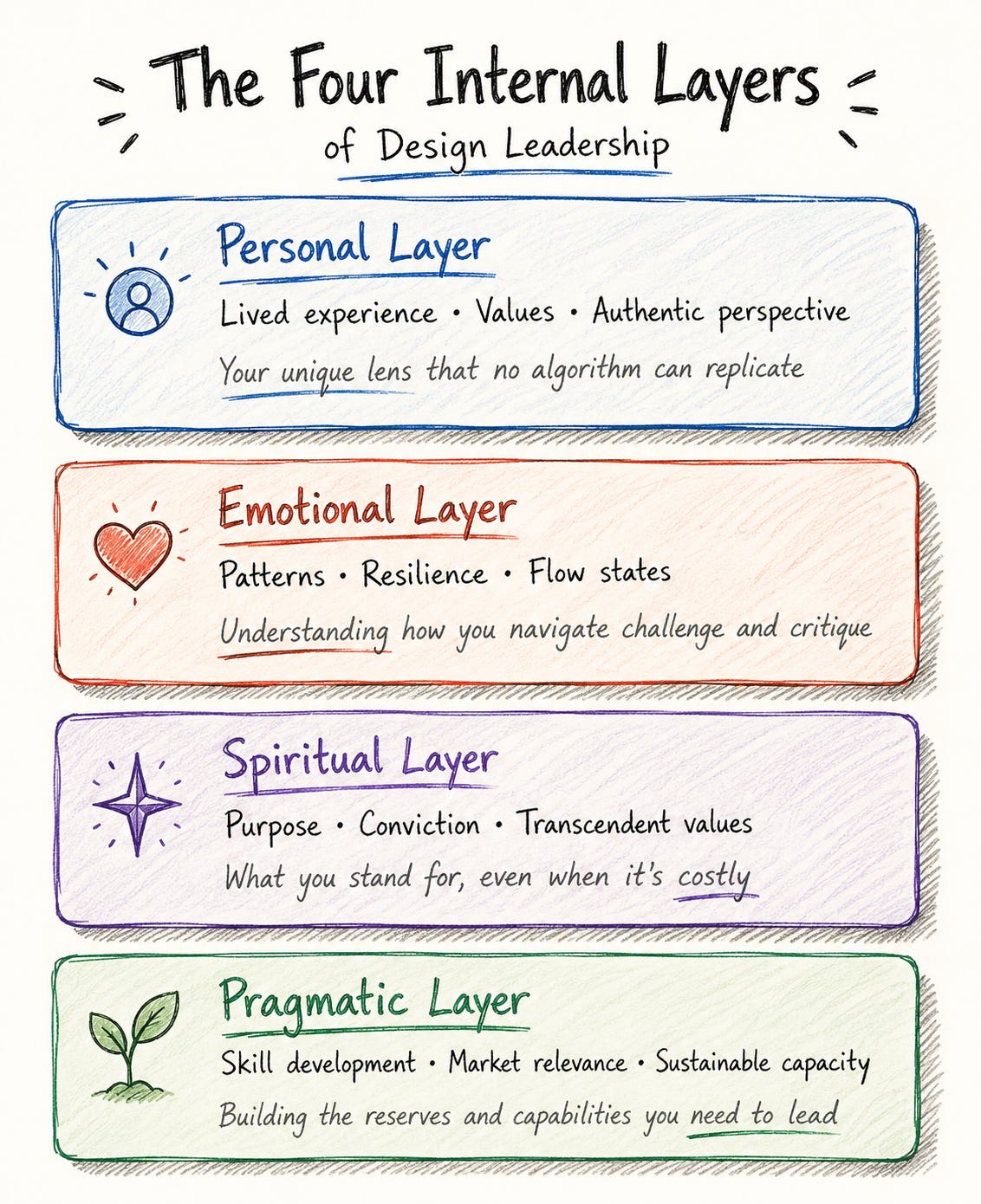
Intact, but reoriented I think…
The personal, emotional, spiritual, and pragmatic layers aren’t simply boxes to complete at mid-year. They are orientations to cultivate across the arc of a career.
Living things naturally change. Your relationship to them changes, too.
The same question asked at different moments in your life will produce different answers, with varying textures & degrees of clarity.
What felt resolved three years ago may become unsettled again.
A pragmatic problem may reveal an emotional pattern. A difficult project may expose a personal history you didn’t realize you were carrying into the room. The mid-year moment is still useful, then—not as a checkpoint on a progress report, but as an occasion to notice where you are in the flow.
What feels more settled than it did six months ago? What feels newly unsettled?
Which layer is asking for attention right now—not because a rubric says so, but because something in you already knows? 🤔
This requires something the industry rarely names: volitional time.
Not free time. That never really arrives, especially in the current era of speed for its own sake…
Volitional time is time deliberately chosen against all the clock-time demands that appear more immediate: the next deliverable, the next sprint, the next career milestone.
It is the choice to sit with a difficult question rather than resolve it prematurely. To let an experience settle before extracting its lesson. To return to the layers because something within you recognizes the need, even when nothing on the calendar requires it.
Indeed, choosing durée over the convenient dashboard of measurable task efficiency is a small act of resistance.
But the alternative—confusing the map for the terrain, the plan for the development itself—costs more. It may cost you the very thing you were trying to build.
Leadership development, at its deepest level, doesn’t simply happen IN time.
It happens AS time: through the continuous, accumulating, irreversible flow of experience that makes you, slowly and often invisibly, into someone different than you were. 😏
Someone with deeper roots. A clearer North Star. A more honest relationship with your own patterns & histories…
You can’t schedule that on a clock. You certainly can’t simply AI automate it.
But you can choose, again and again, to show up for it. 🙏🏽
Some of this you can do alone. Some of it goes faster with company. I coach designers through exactly this. Reach out if that's useful.